The Burning Sea
Executive Summary
The Burning Sea is not a true ocean, but a vast inland desert region of salt flats, scorched badlands, broken stone, dry trade roads, hidden cisterns, monster-haunted wastes, and impossible cities built wherever water, magic, or force of arms makes settlement possible.
The region is crossed by the Golden Road, the great north-south caravan route that links Wallhaven, Caeruleum, Khanen, Kijah, and the northern pass toward Mar Ganus. The road is the spine of the region. Every caravan, toll fort, beast market, city-state, and bandit lord either depends on it or preys upon it.
To outsiders, the Burning Sea is empty. To those who know it, it is crowded with law, hunger, memory, and old power.
Overview
Region Type: Desert, salt marshes, badlands, wasteland, ruined steppe, river edge
Major Settlements: Kijah, Khanen, Caeruleum, Wallhaven, Belath, Mar Ganus
Secondary Settlements: Borfa, God Forge, scattered caravanserai, toll keeps, oasis towns
Estimated Population: Approximately 750,000 across the wider region
Primary Peoples: Common humanoids, genasi, half-giants, giants, gnolls, drow, dwarven caravanners, desert tribes
Major Route: The Golden Road
Known For: Desert trade, harsh travel, salt dunes, caravan cities, planar beasts, lost tombs, cloud palaces, ancient ruins
Religion: Talic, Torgo, local totems, ancestor cults, elemental rites, standard Free Lands worship
Tone: Harsh frontier trade region; beautiful, dangerous, ancient, profitable, and politically fragmented
Description
The Burning Sea stretches across the central desert lands of the eastern Free Lands, a broad belt of heat, salt, stone, and wind lying between greener protectorates, river routes, mountain holds, and the northern edge of the Shattered Woods.
Its name comes from the way the horizon shimmers at midday. Caravanners say that at noon the dunes look like red water, the salt pans gleam like whitecaps, and the badlands ripple as if the earth itself has caught fire.
The region is not empty. It contains cities, roads, shrines, monster ranges, dry riverbeds, ancient battlefields, half-buried temples, and deep wells older than any living dynasty. It is a place where distance is political. A town that controls water controls life. A city that controls a pass controls trade. A guild that controls maps may control both.
Themes
| Theme | Details |
|---|---|
| Water is Sovereignty | Wells, cisterns, portals, canals, and river access define power. No authority lasts long without water. |
| The Road is Civilization | The Golden Road is not merely a highway; it is law, commerce, news, marriage, taxation, and survival. |
| Wonder with Teeth | Caeruleum’s miracles, Khanen’s planar beasts, and Kijah’s river markets are beautiful, but each has a price. |
| Harsh Hospitality | Refusing water is a grave insult. Offering it may be kindness, obligation, trap, or political theater. |
| City-States, Not Kingdoms | No single ruler controls the Burning Sea. Power rests in cities, councils, warlords, guilds, and road agreements. |
| Old Things Beneath Sand | Tombs, dead empires, efreeti ruins, buried heroes, and broken planar sites still shape the present. |
Map and Regional Position
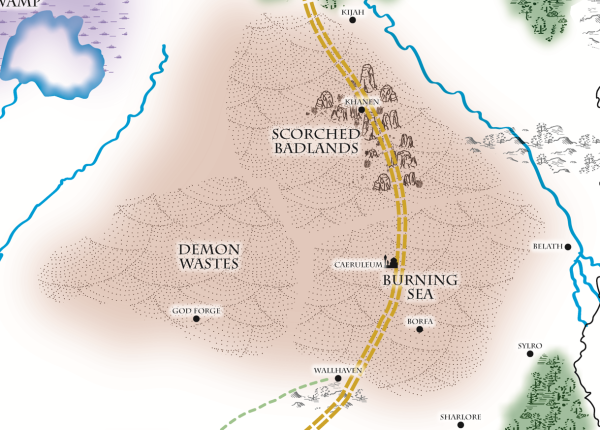
The Burning Sea lies along the great north-south road corridor running from Wallhaven in the south, through Caeruleum, past Khanen, toward Kijah, and finally north to Mar Ganus and the lands beyond.
The attached regional map shows the Golden Road cutting through the heart of the region:
- Wallhaven anchors the southern approach.
- Caeruleum rises as the great wonder-city of the inner desert.
- Khanen commands the plateau and beast markets along the central road.
- Kijah marks the northern river edge and the transition toward greener lands.
- Mar Ganus guards the northern mountain and forest approach.
- Belath, Sylro, and Sharlore sit east and southeast of the main desert road, linked more strongly to Wallhaven’s protectorate system.
- Borea and God Forge sit beyond the main artery, useful to merchants, miners, pilgrims, and the desperate.
History
Before the Road
Before the Golden Road was formalized, the Burning Sea was crossed by seasonal paths, tribal routes, beast trails, and guarded water-lines known only to guides and desert families. Travelers moved by stars, cairns, salt ridges, and the memory of wells.
Older ruins suggest that the region was once greener in places, or at least more heavily settled. Stone foundations, buried canals, broken statues, and half-swallowed towers appear after sandstorms. Some are harmless. Others are sealed for good reason.
The Age of Salazaar
Much of the Burning Sea’s oldest fear is tied to Salazaar, the Tyrant Efritti whose legacy still clings to tombs, glassed sand, cursed wells, and old heroic songs. The details vary by city, but most traditions agree on three points:
- Salazaar ruled or terrorized a portion of the desert in an age of fire.
- Four heroes rose against him.
- Something from that struggle remains unfinished.
Modern scholars, relic hunters, and political patrons continue to search the desert for proof of the old stories. The problem is that some stories prefer to remain buried.
The Making of the Golden Road
PENDING
The Rise of the City-States
The major cities of the Burning Sea survived by mastering different necessities:
- Caeruleum mastered water and wonder.
- Khanen mastered beasts, breeding, and plateau defense.
- Kijah mastered river access and trade transition.
- Wallhaven mastered discipline, artillery, engineering, and civic defense.
- Mar Ganus mastered the northern gate, mountain access, and road control.
Together they form a region of interdependence without unity. They trade with one another, bargain with one another, resent one another, and occasionally save one another from disaster.
Recent Events
Recent archaeological expeditions out of Caeruleum have stirred renewed interest in old Burning Sea tombs, especially after reports of preserved heroic remains, missing relics, and sudden political suppression. The fall of favored expeditions has unsettled scholars, mercenaries, and lower-ward operators alike.
Meanwhile, refugee movements, Wallhaven’s expanding protectorate interests, Khanen’s beast markets, and Kijah’s river politics have made the Golden Road more important and more dangerous than it has been in years.
Government and Leadership
The Burning Sea has no single government. It is a region of city-states, local rulers, councils, road compacts, toll lords, guild interests, tribal claims, and armed agreements.
| Power | Role in the Region |
|---|---|
| Caeruleum | The greatest wonder-city of the region; controls portal-fed waterworks, magical markets, and desert scholarship. |
| Khanen | Plateau city ruled by the Horse Lords; controls exotic beasts, planar breeding programs, and caravan animal supply. |
| Kijah | River-edge merchant city; controls northern trade transition, brown-water docks, and river access. |
| Wallhaven | Southern martial power; controls roads, protectorates, artillery interests, and disciplined trade security. |
| Mar Ganus | Northern gate settlement; controls the pass between desert road, mountain approaches, and Shattered Woods routes. |
| Caravan Guilds | Maintain schedules, contracts, credit, guards, and road intelligence. |
| Road Wardens | Local protectors, toll officers, scouts, and fortified waystation commanders. |
| Desert Tribes | Hold ancestral routes, hidden wells, and knowledge no city truly owns. |
| Beast Clans and Handlers | Associated strongly with Khanen; provide mounts, guards, and desert-trained animals. |
| Smugglers and Safe-Route Brokers | Move people or goods outside official road law. |
Regional diplomacy is usually conducted through contracts, caravan rights, marriage arrangements, water access, military escorts, and carefully worded insults.
Major Settlements
Caeruleum
Caeruleum, the Jewel of the Burning Sea, is the region’s great wonder-city. It is a rainless desert metropolis of gold domes, blue canals, enchanted markets, cloud giant palaces, and impossible waterworks fed by a stabilized portal to the Elemental Plane of Water.
Caeruleum is beautiful, learned, stratified, and suspicious. Its water is miracle, infrastructure, and political weapon all at once.
Regional Role: Arcane hub, water miracle, scholarly center, luxury market, archaeological patron city.
Khanen
Khanen is the Plateau City, ruled by the Horse Lords: a council of warlords, breeding masters, and beast-lineage authorities. Built atop a wind-scoured mesa, Khanen is famed for exotic beasts, planar-touched mounts, training rings, auction blocks, and glyph-marked stables.
Its markets are loud, dangerous, and profitable. A caravan without Khanen-bred mounts is slower, weaker, and less respected.
Regional Role: Beast market, caravan animal supplier, plateau fortress, mercenary and handler culture.
Kijah
Kijah is known as the Gateway to the Eastern Lands. It stands where the badlands give way to water, river trade, and the northern edge of the Shattered Woods. Caravans, riverboats, smugglers, merchants, and wandering warbands all pass through its gates.
Kijah is both fortress and marketplace. Its Desert Breeze Plaza, Rivergate Citadel, brown-water docks, and trading houses make it one of the most important transition points in the region.
Regional Role: River access, northern trade gate, merchant city, smuggling crossroads.
Wallhaven
Wallhaven anchors the southern end of the main road corridor. Though not culturally a desert city, its survival and economy are tied to the road. Wallhaven needs horses, textiles, timber, river access, smokepowder routes, and trade partners beyond its walls.
Its soldiers, engineers, artillery officers, and road wardens are respected throughout the southern Burning Sea, though not always loved.
Regional Role: Southern road anchor, martial power, engineering center, protectorate authority.
Mar Ganus
Mar Ganus marks the northern road-gate where the Golden Road approaches the mountain and forest edge. It stands at the transition between Burning Sea trade, Shattered Woods danger, and dwarven or northern route politics.
Until its own article is expanded, Mar Ganus can be treated as a fortified pass settlement: part caravan gate, part watch fortress, part customs house, and part survival market for those entering or leaving the harsher desert routes.
Regional Role: Northern pass-gate, customs station, fortified road control, dwarf-linked trade.
Belath
Belath lies east of the core Burning Sea route, but remains important because it links Wallhaven’s protectorate to river and sea trade. Belath’s docks, warehouses, and smokepowder connections make it a distant but influential player in regional logistics.
Regional Role: River city, northern sea trade, smokepowder access, Wallhaven protectorate link.
God Forge
God Forge lies toward the Demon Wastes and is spoken of with a mix of reverence and caution. Some claim it is a dwarven industrial holy site. Others describe it as an old forge-temple, ruin, or monster-haunted salvage ground.
Regional Role: Pilgrimage point, forge-ruin, dangerous trade detour, dwarven and relic interest.
Geography and Climate
The Scorched Badlands
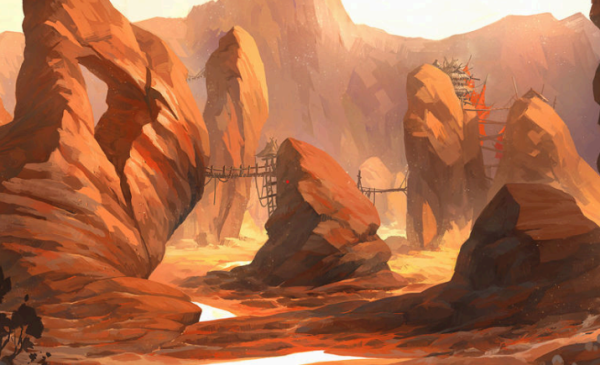
The Scorched Badlands dominate the central road between Kijah, Khanen, and Caeruleum. The land is dry, jagged, and wind-cut, with red stone, salt dust, narrow ravines, and strange standing formations.
Travelers here fear heat, thirst, ambush, collapsing ledges, and storms that strip paint from wagons.
The Salt Dunes
The salt dunes are white, bright, and deadly. They confuse distance, burn exposed skin, and ruin unprotected supplies. At dawn they can look almost beautiful. At noon they are torture.
Caravans cross them quickly or not at all.
The Demon Wastes
The Demon Wastes lie west and southwest of the main road. They are avoided by sensible caravans. The wastes contain broken ground, old ruin fields, mutated beasts, and places where prayers seem to arrive late.
God Forge stands near this influence, which may explain both its importance and its danger.
The Shattered Woods Edge
North of Kijah and near Mar Ganus, the desert gives way to the Shattered Woods. This transition is not gentle. Trees grow dense, rivers cut strangely, and old forest paths do not always lead where maps suggest.
The northern road is less thirsty than the desert, but not necessarily safer.
The River Country
Kijah’s river system carries trade eastward and gives the northern Burning Sea access to brown-water docks, reed coves, riverboats, smugglers, and wetland dangers. To desert travelers, river smell means salvation. To riverfolk, desert travelers smell like money.
The Plateau Lands
Around Khanen, the land rises into mesas, cliffs, and wind-scoured stone. Plateau roads are difficult for ordinary wagons, but ideal for defensible corrals, tiered markets, and watchtowers.
Khanen’s geography is one reason the Horse Lords endured.
The Golden Road
The Golden Road is the central artery of the Burning Sea. It is usually shown as a broad north-south route, but in practice it is a chain of roads, waystations, caravan yards, toll gates, guarded cisterns, and alternate tracks.
A typical south-to-north route is:
- Southern road forts and caravanserai
- Borfa detour or central road camps
- Badlands road and Gateway Arch approaches
- Shattered Woods edge
Road Customs
Common road customs include:
- Never refuse water to a traveler unless declaring enmity.
- Never ask a guide to reveal a hidden well in public.
- Pay beast-handlers before entering the worst badlands.
- Count guards at every waystation.
- Trust shade more than distance.
- Never follow lanterns off-road after sunset.
- A blue-marked cistern is public; a red-marked cistern is claimed; an unmarked cistern is a question.
Road Wardens
Road Wardens are not a single organization. The term is used for Wallhaven patrols, city-funded guards, caravan officers, toll soldiers, Khanen outriders, Kijah scouts, and private contract protectors.
A Road Warden’s authority lasts only as far as someone is willing to respect it.
Economy
The Burning Sea economy is built around movement, scarcity, and control.
Primary Industries
- Caravan trade.
- Water rights and cistern maintenance.
- Beast breeding and animal handling.
- Magical items and enchanted curios.
- Archaeology and relic recovery.
- Salt, glass, mineral pigments, and desert stone.
- Spices, preserved foods, dried fruits, and desert medicines.
- Luxury hospitality in major cities.
- Mercenary work and escort contracts.
- Smuggling, safe-route brokerage, and black-market maps.
Exports
- Planar-touched mounts from Khanen.
- Element-infused goods from Caeruleum.
- Desert relics and authenticated antiquities.
- Salt, glass, pigments, rare minerals, and carved stone.
- Fine beasts, saddles, reins, fetters, and handler gear.
- Alchemical reagents and preserved desert herbs.
- Maps, guide contracts, and route intelligence.
Imports
- Grain.
- Timber.
- Cloth.
- River goods.
- Metalwork.
- Smokepowder.
- Fresh fruit and luxury food.
- Laborers, guards, scholars, and adventurers.
- Spell components difficult to find in dry lands.
Currency
Standard coinage is accepted in all major cities, but barter remains common in remote areas. Water, mounts, guide contracts, healing, maps, and letters of passage may be worth more than gold on the wrong stretch of road.
Culture and Society
The Burning Sea has no single culture. It is a corridor of overlapping city customs, caravan laws, tribal memory, merchant etiquette, desert taboos, and survival practices.
Common Values
- Practical hospitality.
- Respect for guides.
- Suspicion of waste.
- Pride in endurance.
- Strong memory for debts.
- Public bargaining and private arrangements.
- Reverence for water, shade, and safe passage.
Languages
Common languages include:
- Common.
- Giant.
- Undercommon.
- Elven.
- Dwarven.
- Goblin trade cant.
- Local caravan signs and road marks.
Religion
Religion varies by settlement and route. Talic is widely honored in connection with nature, survival, and the harsh balance of the land. Torgo is invoked by disciplined travelers, road wardens, and caravanners seeking safe passage. Khanen maintains tribal totems and beast-lineage rites. Caeruleum’s public life is more secular and civic, though water, stars, and elemental imagery carry near-religious weight.
Some travelers also leave offerings to nameless well-spirits, dead guides, desert ancestors, or the Four Heroes of the Salazaar cycle.
Traditions
| Tradition | Description |
|---|---|
| The First Waters | A caravan’s first opened water skin is shared by all ranked members before departure. |
| Salt Oaths | Contracts sworn over salt are considered binding among desert traders. |
| The Last Shade Rule | No traveler may claim the final shade at a rest stop if children, animals, or the wounded remain exposed. |
| Dust Naming | Beasts that survive their first full Burning Sea crossing receive a road-name. |
| Lantern Watch | Camps maintain visible lanterns by road and hidden lanterns for scouts. |
| The Empty Cup | A cup placed upside down before a guest means water cannot be spared without payment or oath. |
| The Courtesy of Water | The quality, temperature, and vessel of offered water can signal welcome, insult, fear, or rank. |
Notable Organizations
| Organization | Description |
|---|---|
| The Golden Road Merchant Syndicates | Powerful trade interests moving goods through Caeruleum, Kijah, Khanen, and Wallhaven. |
| The Horse Lords of Khanen | Warlords and breeding masters who control Khanen’s beast economy. |
| The Council of Wise Women | Formal civic authority of Caeruleum. |
| Wallhaven Road Wardens | Disciplined patrols and officials protecting Wallhaven’s road interests. |
| Kijah Merchant Council | River and desert trade leadership in Kijah. |
| The Moonjackals | Safe-route brokers and lower-ward operators associated with Caeruleum’s Shadeward politics. |
| Blackwolf & Company | Fallen Caeruleum expedition family now tied to lower-ward holdings and dangerous desert secrets. |
| Desert Guide Clans | Families and tribal networks who know wells, old paths, and forbidden routes. |
| Cistern Keepers | Local technicians, priests, guards, and families responsible for maintaining road water points. |
| Sand-Bond Caravans | Long-distance caravan families bound by oath, marriage, and shared guard contracts. |
Threats and Challenges
Environmental Hazards
- Killing heat.
- Salt blindness.
- Flash floods in dry ravines.
- Sandstorms.
- Glass dunes.
- Poisoned wells.
- Collapsing badland shelves.
- Mirage fields.
- Night cold.
- Route markers buried or moved by wind.
- Water theft.
Monsters and Hostile Creatures
- Gnoll warbands.
- Giant scorpions.
- Ankhegs and burrowing horrors.
- Rocs and desert wyverns.
- Planar-touched beasts escaped from Khanen bloodlines.
- Elemental spirits.
- Salt undead.
- Desert giants.
- Drow raiders from hidden underways.
- Things from old Salazaar ruins.
Political Strife
- Caeruleum’s water politics.
- Khanen breeding-contract disputes.
- Kijah smuggling and river corruption.
- Wallhaven’s protectorate expansion.
- Mar Ganus toll and pass disputes.
- Caravan guild rivalries.
- Tribal claims ignored by city maps.
- Relic hunters awakening old dangers.
- Refugees and displaced road communities.
- Sabotage of cisterns, bridges, and waystations.
Landmarks
| The Golden Road | The main caravan artery of the Burning Sea. Its gold-marked route is treated as the difference between civilization and death |
|---|---|
| The Gateway Arch | A pair of weathered stone pillars south and east of Kijah marking the threshold between river trade and the brutal badlands road |
| The Tears of Salazaar | A dangerous region, relic, ruin-field, or mythic scar associated with the old tyrant. Merchants use the name freely; scholars use it carefully |
| The Rift Pens | Khanen’s dangerous planar breeding grounds near a minor rift. Heavily guarded, heavily warded, and never as controlled as the Horse Lords claim |
| The Aquavault | Caeruleum’s great water-control system, where impossible portal-water is measured, warded, stored, and distributed |
| The Shadeward | Caeruleum’s lower-ward maze of canals, lamps, markets, safehouses, and pressure networks. Many road secrets eventually find their way here |
| God Forge | A dangerous forge-site or ruin near the Demon Wastes, tied to dwarven craft, pilgrimage, relic salvage, and old fire |
| The Shattered Woods Edge | The northern green boundary where the desert road approaches the forest. It offers shade, water, and fresh terror |
Services
Common services available along the Burning Sea include:
| Service | Common Location | Notes |
|---|---|---|
| Caravan Escort | Wallhaven, Kijah, Caeruleum | Quality varies from veteran soldiers to desperate sellswords. |
| Beast Purchase | Khanen | Mounts, pack animals, warbeasts, planar-blooded creatures. |
| Water Writs | Caeruleum, major road offices | Legal proof of water rights, cistern access, or canal allotments. |
| Desert Guides | Kijah, Khanen, road camps | Essential for anyone leaving the marked road. |
| Relic Appraisal | Caeruleum, Kijah markets | Honest appraisal is rare; safe appraisal is rarer. |
| Cartwrights and Wheelwrights | Every major city | The desert eats wheels. |
| Beast Healing | Khanen | Herbal, magical, and practical care for animals. |
| Smuggler Passage | Kijah, Shadeward, Borfa | Expensive and politically risky. |
| Map Brokers | Caeruleum, Kijah | Maps may be outdated, stolen, cursed, or intentionally wrong. |
| Cistern Repair | Road forts and waystations | Often funded by guilds or cities; sometimes sabotaged. |
See Also
Misc